Approvals & spend requests
AxisFlow sits between the person who needs something and the money that pays for it. Requests, orders, invoices and contracts each carry their own approval chain — and, six months later, a record of who was asked and why.
Set up in an afternoon · Works on a phone · Reads your accounts, never writes to them
The problem
A site engineer needs cable. He calls the buyer, the buyer calls the supplier, and eight weeks later an invoice arrives that nobody recognises for a price nobody agreed. AxisFlow is the three minutes in the middle that makes the other eight weeks work.
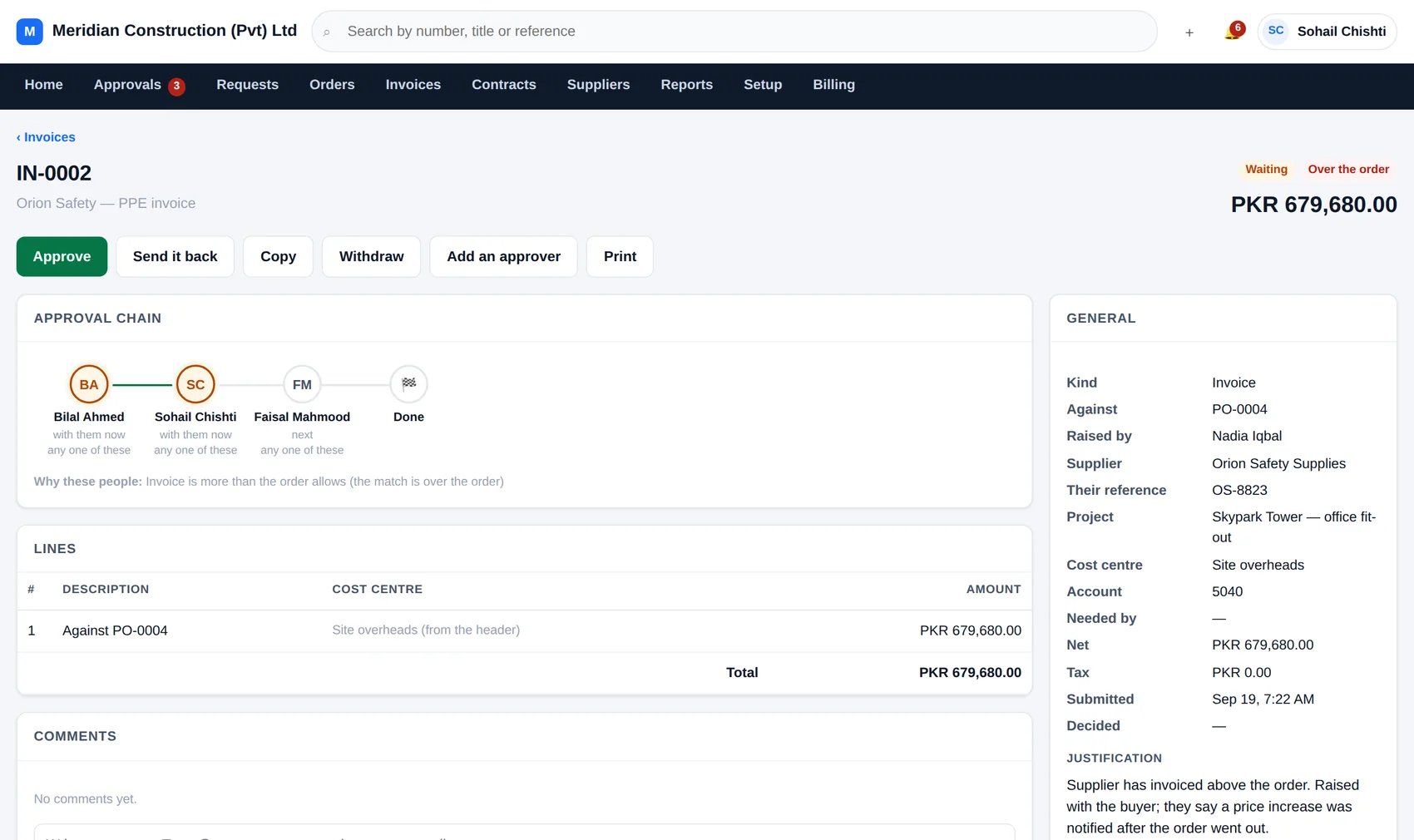
You write rules once — by value, cost centre, project, supplier or category. Every request that arrives is tested against them and the matching steps are strung together into its chain. Nobody has to remember who signs what.
The chain is stamped onto the request at the moment it is submitted. Change a rule next month and next month's requests change — what already happened stays exactly as it happened. That is what makes the record worth keeping.
Things sit. That is the one failure every approval system has. AxisFlow emails the person it is waiting on after a few days, and copies their manager in after a week. It never approves anything itself — it only says so.
For the person deciding
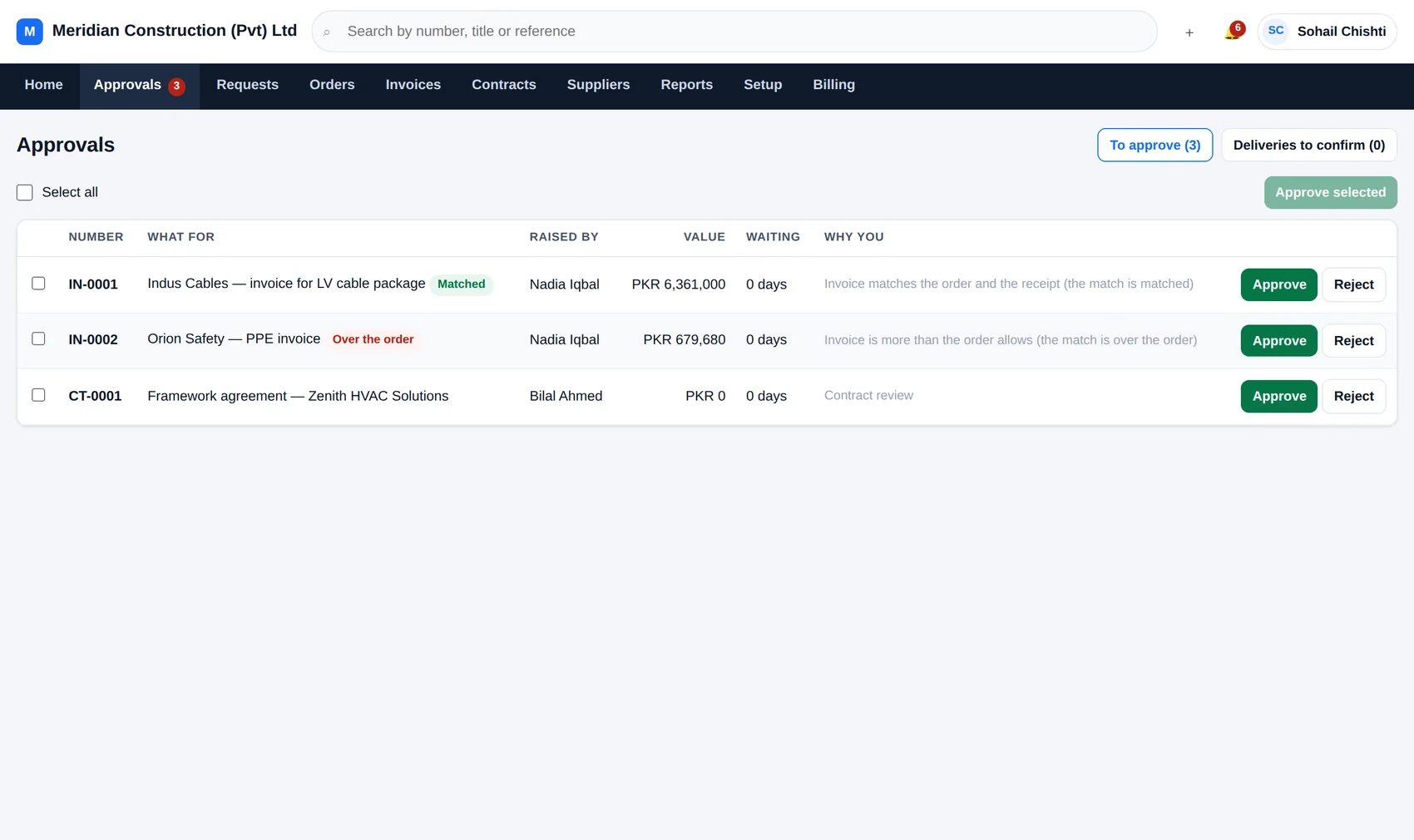
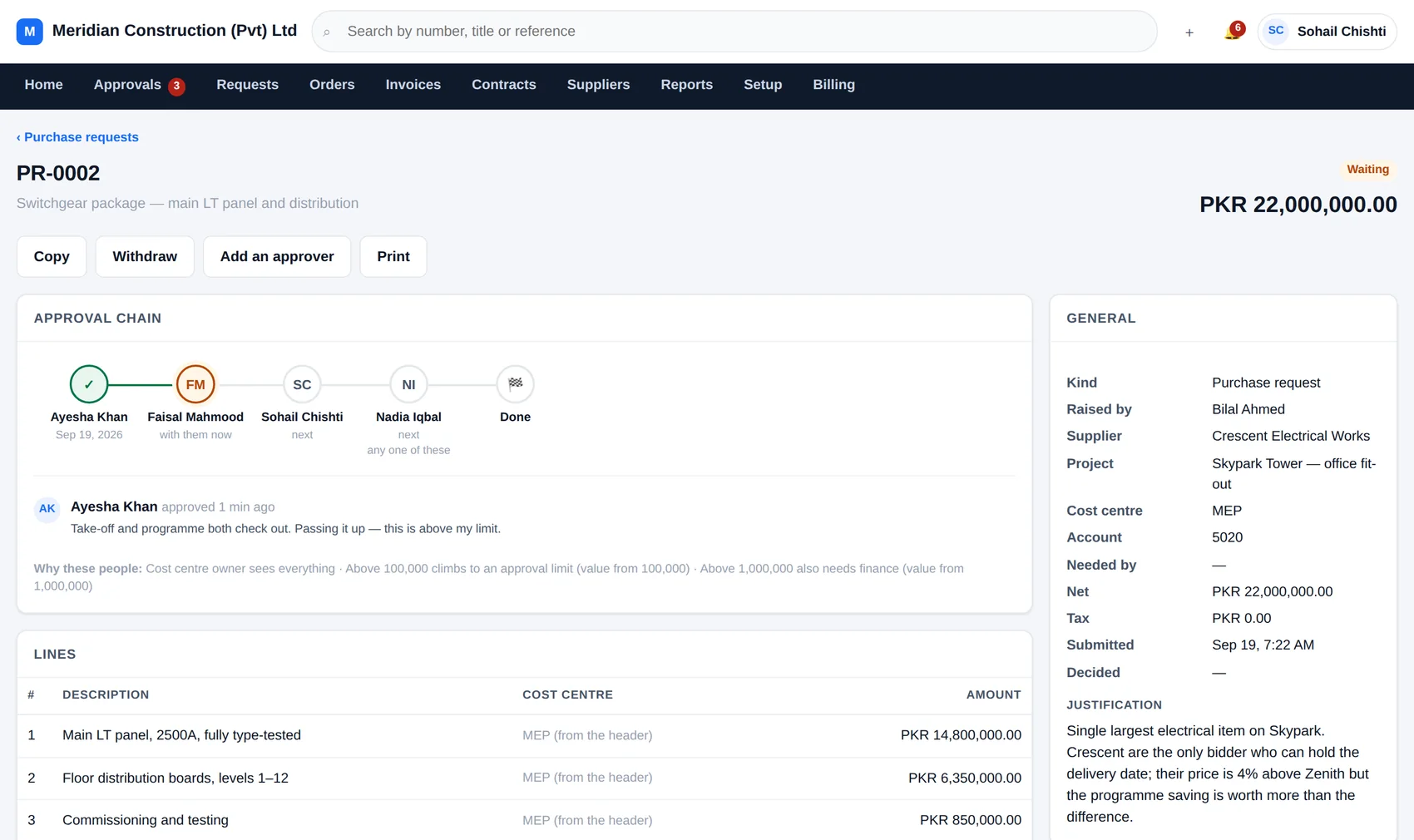
Open the inbox and approve, send back with a reason, or add the person who should really be looking at it. The value, the budget position and the justification are on the same screen as the button, so nobody has to go and find out before deciding.
For whoever sets the policy
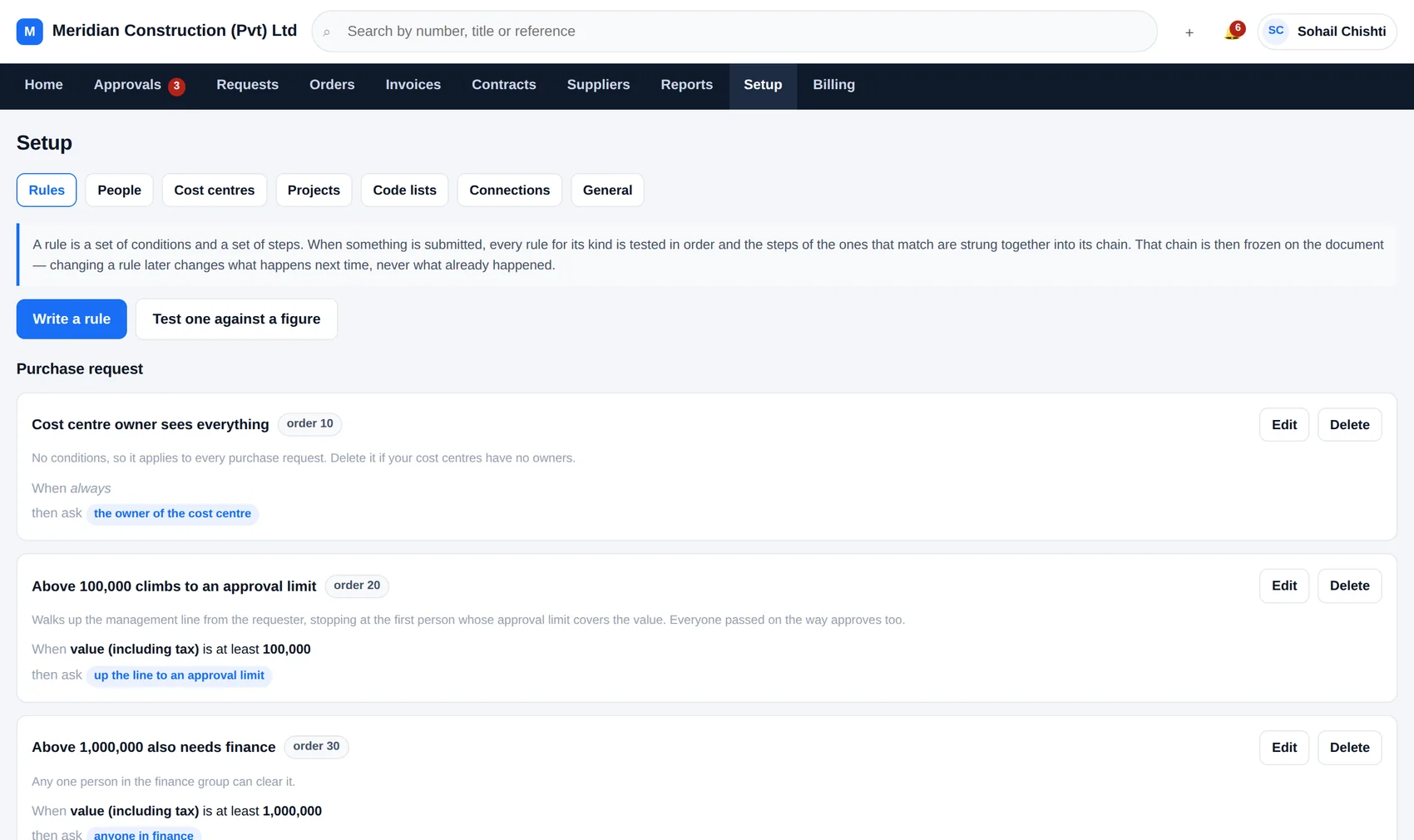
“Anything over a million also needs finance.” “The cost centre owner sees everything.” “Above a hundred thousand, climb the management line until somebody's approval limit covers it.” Each of those is one rule, written on one screen, and you can test it against a figure before you turn it on.
For finance
Every invoice is checked against the order it belongs to and against what was actually received. Inside your tolerance it goes through. Outside it, it stops and says which of the three disagrees — before the payment run, not after it.
The shape of it
Each step knows about the one before it. Nothing is re-typed, and the number on the invoice can be traced back to the person who first asked for the thing.
A request with lines, a project, a cost centre and a reason. The quotation goes on with it.
Rules are tested, the approvers are chosen, and everybody is told at once who is involved.
Approved, or sent back with a reason. Budget position is on the screen while the decision is made.
The approved request becomes a purchase order, carrying its lines and its supplier across.
Whoever received it says what arrived, in full or in part, against the order lines.
Order, receipt and invoice compared. Agreement passes; disagreement stops and explains itself.
The number that matters
Committed money is the number that ruins projects, because it is spent before it is spent. AxisFlow shows the whole ladder — what was asked for, what got through, what is on order, what arrived and what has been billed — for the company, a project or a single cost centre.
Sample workspace · all projects · Pakistani rupees
Invoiced sits above delivered because one supplier has billed for goods nobody has confirmed arriving. That is the gap AxisFlow is for — and it is holding that invoice until somebody explains it.
Alongside what you already run
Cost centres, suppliers and actual spend are pulled across so approvers see the real budget position while they decide. Nothing goes back the other way — not a status, not a flag, not a log line. Your accounts stay the only place accounts are kept.
One small file in your accounting folder hands over cost centres, suppliers and what has actually been spent. Read-only, by design, and you can read the file yourself to check that.
A panel on each project showing what is committed, what is waiting and what is stuck — drawn straight from AxisFlow, without anybody signing in twice.
Perfectly fine. AxisFlow keeps its own list of projects, cost centres and suppliers and works on its own from the first afternoon. Connect things later, or never.
Pricing
Start free on one project. Move up when there are more of you. No charge for the people who only ever approve things.
An afternoon. Sign up, add your people and their managers, list your projects and cost centres, and look at the fourteen rules that are already there. Most companies change three or four of them and leave the rest alone.
They need an account, and it counts towards the number of people on your plan. But there is no separate approver licence and no extra charge for somebody who only ever opens AxisFlow to say yes.
Nothing is deleted while the account exists. You can export everything — documents, lines, approvals, comments and history — as a single file, at any time, without asking us.
Yes. It is plain PHP and MySQL in two folders, and it runs on ordinary shared hosting. Get in touch and we will talk about what that looks like for your team.
Most accounting systems record a purchase order beautifully and have almost nothing to say about the twenty days before it existed. AxisFlow is those twenty days: who asked, who agreed, who was ignored, and what the budget looked like at the moment somebody said yes.
It was built for contractors, so it thinks in projects, cost centres and site deliveries. Anybody who commits money against a job rather than against a department will recognise the shape of it.
Free for a small team, for as long as you like. No card, no call, and nothing to install — your workspace exists about ten seconds after you sign up.